


Custom Traditional Ink Painting Manufacturer
Jiaxing Zhongmeng Thermal Insulation Material Co., Ltd is located in Jiaxing, Zhejiang, China. The main creators have decades of Chinese painting creative experience and have many honors. The company now has more than a dozen employees and is currently under development.
Why Choose Us
Customize Product
We provide customized sizes, and customized frameworks, and can modify the color of the painting according to customer requirements.
Retail and Wholesale Service
We provide retail and wholesale services for individuals and enterprises of various scales. We are selling Chinese paintings at the right price, and establishing long-term business relationships.
Professional Service Team
We have a dedicated customer service team that can guide you to choose. From creation to mounting, it is completed by the company, which ensures the integrity of the product and its packaging to the greatest extent.
Excellent Technology
Chen Zhiliang's Chinese painting and calligraphy works have participated in the exhibitions of esteemed institutions such as the China Artists Association, the Chinese Calligraphers Association, and the Xiling Seal Society, garnering accolades and recognition within the art world.

Famous Traditional Sumi E Painting
These renowned artworks stand as emblematic pieces of traditional sumi-e, capturing the elegance, simplicity, and cultural depth that has enchanted generations. The tools used for Sumi-e painting include ink sticks, a grinding stone, brushes made of animal hair, and high-quality paper. The ink is made by grinding the ink sticks on the grinding stone with a little water to create a smooth and consistent mixture.

Famous Traditional Chinese Ink Art
Famous Traditional Chinese Ink Art represents an embodiment of Chinese culture, reflecting its centuries-old artistic traditions, spiritual depth, and historical significance. The paintings unfold captivating stories of the past, cultural symbolism, and the evolution of Chinese art, offering a deep connection to history.

Shui Mo painting is a form of Chinese traditional art that utilizes water and ink to create monochromatic paintings. Shui Mo, which translates to "water and ink," is also known as ink wash painting or sumi-e painting. This style of painting dates back to the Tang dynasty (618–907 AD) and has evolved over time to become a celebrated art form in China and around the world. In shui mo painting, the artist uses a brush and ground ink to create intricate and detailed monochromatic works of art.

The painting is created by applying ink to paper using various brush strokes and techniques. The strokes range from thin and delicate to bold and powerful, and each has its own unique meaning and symbolism. The subject matter of Traditional Ink Art includes a variety of landscapes, flowers, birds, and animals, as well as calligraphy and abstract forms. The painting aims to capture the essence of the subject matter, rather than its physical appearance.

Traditional Chinese Ink Drawings
In Traditional Chinese Ink Drawings, the artist uses a brush and ground ink to create intricate and detailed monochromatic works of art. The process requires a high level of skill and patience, as the painter must control the flow of water and ink to create varying levels of intensity and shade in the final product. The result is often a piece that captures the essence of the subject matter, showcasing its beauty and simplicity.

Old Chinese ink painting, also known as traditional Chinese ink painting, is a type of art that originated in China around 3,000 years ago. This form of painting involves using black ink on rice paper or silk to create monochromatic images that evoke a sense of calm, simplicity, and harmony. It was initially used to depict landscapes, flowers, and birds, but over time, it evolved to include a wide range of subjects, from figures and animals to abstract compositions.

Famous Traditional Chinese Ink Painting
Traditional Chinese ink painting is a unique form of art characterized by its use of East Asian brush techniques and black ink on rice paper. This art form has been practiced in China for over a thousand years and is deeply rooted in Chinese philosophy and culture. In Chinese ink painting, the focus is on the expression of the artist's emotions and creative imagination rather than the reproduction of visual reality.

Ancient Chinese Ink Painting preserves China's rich cultural heritage, offering a glimpse into the artistic traditions, symbolism, and narratives of bygone eras. The materials used in Chinese ink painting are simple and traditional. Ink sticks, which are made from soot and glue, are ground with water on an ink stone to create the ink solution.

Traditional Chinese ink painting, also known as shui-mo hua or wash painting, is a form of painting that uses black ink and water on rice paper. It has been practiced for over a thousand years and is considered one of the highest forms of Chinese art. The technique involves using a brush to apply the ink in fluid strokes, utilizing different levels of pressure to create varying shades of black and gray.
Definition of Traditional Ink Painting
Traditional ink paintings do not attempt to capture the actual physical appearance of a subject, but rather its essential character or quality. Landscape painters, for example, frequently go out and observe nature, then come back to a studio to paint what they have experienced. Many landscapes incorporate empty spaces to suggest light or clouds. A flower may be surrounded by blank paper, or paired with a bird or another flower that exists in a different season or climate. Certain details might be rendered with great care, to emphasize an aspect of the subject matter, while others are left to the imagination. Chinese paintings do not have a single perspective or viewpoint; every area of the painting is interesting to the eye. Landscapes are often painted from a viewpoint above the scene so that many areas can be seen at once. In large scenes or landscapes, the eye is meant to travel along a visual path from one area to another.
Unlike Western painting, traditional Chinese painting has its distinctive characteristics. It does not emphasize the one-point perspective and the change of light and colors on objects. It is free to describe the objects and lays more emphasis on the painter's sentiment and the overall arrangement of the picture.
By means of artistic expression, traditional Chinese painting can be divided into elaborate-style painting, liberal-style painting, and elaborate-liberal-style painting. The elaborate-style painting is drawn and colored orderly and meticulously with the painting brush, it uses extremely exquisite brushwork to describe the objects. Comparatively, the liberal-style painting employs free and concise strokes and ink to describe the appearance and spirit of the objects and express the painter's sensation. it is highly synoptically, and its connotative artistic conception is not conveyed by the overall, but by the partial. When drawing a liberal-style painting, the painter is required to put the painting brush to paper precisely, and his every stroke must be skillful and with high proficiency to express the spirit of the picture. As for the elaborate-liberal-style painting, it is an integrated application of the techniques of both elaborate-style painting and liberal-style painting.
The skill of using strokes and ink is an important part of the formation of Chinese painting. Its strokes have stressed the varieties of thick and thin, swiftness and slowness, with syncopated cadence, turning and breaking, square and round to express the tactile sensation of the objects. In general, Chinese painting uses ink is subtle in the combination of shade and light as entirely shade or light is not good for conveying the spirit of the picture. Its shade part looks wonderful but not mechanical and the light part is delicately beautiful but not gloomy.
Chinese painting is particular in applying colors. Its colors are from natural mineral materials and animal shells. They can bear all kinds of weather and not fade, and they are often applied to the picture level. This way of applying colors pursues the original colors of the objects, the change of light and shadow does not often appear.
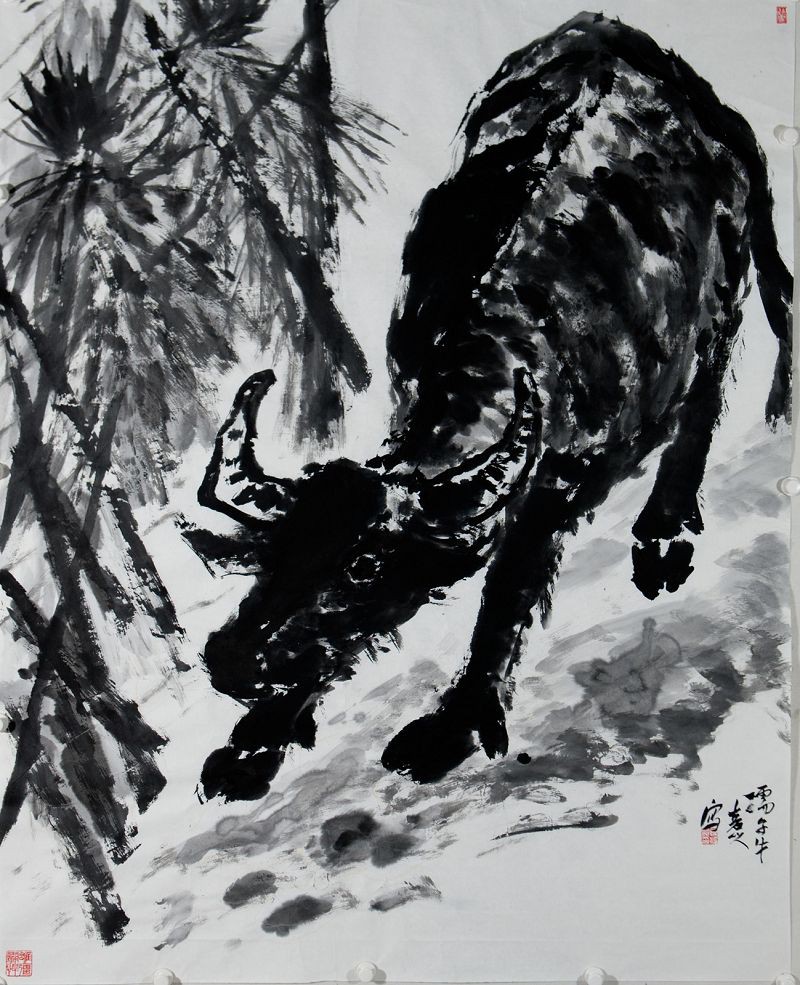
4 Fundamental Traditional Ink Painting Techniques
Dabbing Technique
This technique involves using the brush to dab ink onto the paper in a sequence of dots or short strokes, creating a textured effect. It is commonly used to create more organic designs, such as landscapes, and can be varied in density and pressure to create a range of textures.
Contouring Technique
This technique involves using the brush to outline shapes and forms with ink. Generally, the brush stroke will be thicker and darker at the beginning and end of the stroke, with a thinner, lighter middle. This technique is used to create sharp, precise lines and contours, and is often used in calligraphy or character writing.
Blending Technique
This technique involves using water to dilute the ink and create a gradient effect. The artist will start with a concentrated line or form, and then use a damp brush to blend the edges into a lighter shade. This technique is commonly used to create soft, atmospheric effects, such as clouds or mist.
Splashing Technique
This technique involves using a brush or other tool to flick ink onto the paper, creating a random pattern of splatters and droplets. It is often used as a background effect, or to add texture and movement to a design. The artist can vary the size and density of the splatters, as well as the angle and force of the brush stroke, to create a variety of effects.
Types of Traditional Ink Painting
Landscape Painting
This is a type of traditional ink painting that is used to depict natural scenery such as mountains, rivers, and forests. Many critics consider landscape (shah shui) to be the highest form of Chinese painting. The time from the Five Dynasties period to the Northern Song period (907-1127) is known as the "Great Age of Chinese landscape." In the north, artists painted pictures of towering mountains, using strong black lines, ink wash, and sharp, dotted brushstrokes to suggest rough stone. In the south, artists painted the rolling hills and rivers of their native countryside in peaceful scenes done with softer, rubbed brushwork. These two kinds of scenes and techniques became the classical styles of Chinese landscape painting.
Bird and Flower Painting
Bird-and-flower painting is a genre of Chinese painting devoted to depicting a wide range of natural subjects, including flowers (plants), fish, insects, birds, and pets (dogs, cats). Flower painting derived from the Buddhist banner paintings, brightly decorated with flowers, which were brought into China from India when Buddhism was introduced in the 1st century C.E.. These paintings became popular during the Tang dynasty, and by the 10th century C.E., had become a distinct category of painting (huahua) using its own brush strokes and color wash techniques. Flower painting combined with the Chinese tradition of painting birds and animals. Many artists during the Song Dynasty worked in this genre, producing paintings of such things as plum blossoms, orchids, bamboo, chrysanthemums, pines and cypresses. Certain birds and flowers, such as plum blossoms and nightingales, were always paired. The strokes used to paint the stems of flowers or the beaks of birds were similar to brush strokes used in calligraphy. Bird-and-flower paintings were an expression of the Daoist ideal of harmony with nature. Once an artist mastered the brush techniques for a particular subject, he would gain the ability to express his own inner character and his relationship with nature through a few simple strokes.
Figure Painting
This type of traditional ink painting is used to depict people in different scenarios. Figure ink painting is a style of painting that features the use of ink to create images of people or figures. It is a traditional art form that originated in China and has become popular in many other cultures around the world. In figure ink painting, the artist uses a brush to apply black ink to a white or colored paper surface. The strokes of the brush are varied in thickness and intensity to create depth and texture in the image. The focus is on capturing the essence of the subject rather than creating a photographic representation. Figure ink paintings can range from highly detailed and realistic to minimalistic and abstract. Some artists may also add watercolor or other paint to the ink to create additional effects.
Ultimate FAQ Guide to Traditional Ink Painting
Q: What are the tools for Chinese painting?
Q: What are the materials for Chinese painting?
Q: What are the shapes of Chinese paintings?
Combination of poem, calligraphy, painting and signet
Chinese painting shows the perfect union of poems, calligraphy, painting and signet. Generally, Many Chinese painters are poets as well as calligraphers. He often adds a poem to it personally and stamps his various signets on the painting after he finishes it. The combination of the four makes the painting look more integrated and beautiful, which can bring the appreciator aesthetic pleasure.
Q: How to mount traditional ink paintings?
Q: What are the themes of Chinese traditional ink paintings?
Q: What are the history and origin of Chinese traditional ink paintings?
Brush painting and calligraphy have been highly valued art forms throughout Chinese history. Chinese imperial courts employed court painters to depict a wide variety of subjects and for different uses, from hanging scrolls to the decoration of lacquerware.
From the 13th century, simple subjects that look appealing to our early-21st-century eye became popular: a single flower, fruit, or bird sitting on a branch. These days, traditional subjects from the natural world are still popular, as are traditional inks and brushes. Contemporary Chinese and international artists put a modern spin on classic subjects and materials.
Q: How to start Chinese traditional ink paintings?
After gathering your supplies, it's time to choose a subject. Chinese brush painting classes for beginners tend to focus on just one subject. Traditional Chinese painting uses four "gentlemen" or core motifs-bamboo, plum blossoms, orchids, and chrysanthemums-all of which are good subjects for beginning Chinese brush painting because they'll enable you to practice the brush strokes integral to the art form.
Step 2: Mix Your Inks
Mix your inks in a saucer or palette.
You can use various colors for brush painting, but if you're a complete beginner, start with black ink, mixed into lighter and darker shades by adding more or less water.
Step 3: Sketch the Outline in Pencil
Lightly sketch the outline of your subject, or the main lines and shapes you'll need to follow, with pencil on the rice paper.
Step 4: Begin Painting
Hold the brush correctly to form the strokes of your painting.
The look of your painting will be determined by your mastery of some basic Chinese brush painting strokes, including:
Upright vertical
Oblique
Reverse
Hidden
Exposed
Scatter
Drag
Rub
Dot
Q: What is the purpose of traditional ink painting?
Q: What are the techniques used in traditional ink painting?
Q: How does traditional ink painting differ from Western painting?
Q: What subjects are typically depicted in traditional ink painting?
Q: How has traditional ink painting influenced other forms of art?
Hot Tags: old chinese ink painting, China old chinese ink painting, Chinese Ink and Watercolor Painting, Famous Chinese Brush Paintings, Chinese Ink Brush Painting, E Sumi, Sumi Bamboo Painting, Sumi E Painting